Salary context: Pay ranges in this article are retained estimates from its earlier edition, not a newly verified survey. Check dated sources for comparable roles, experience, location, and fixed versus total pay before relying on them.
Overview
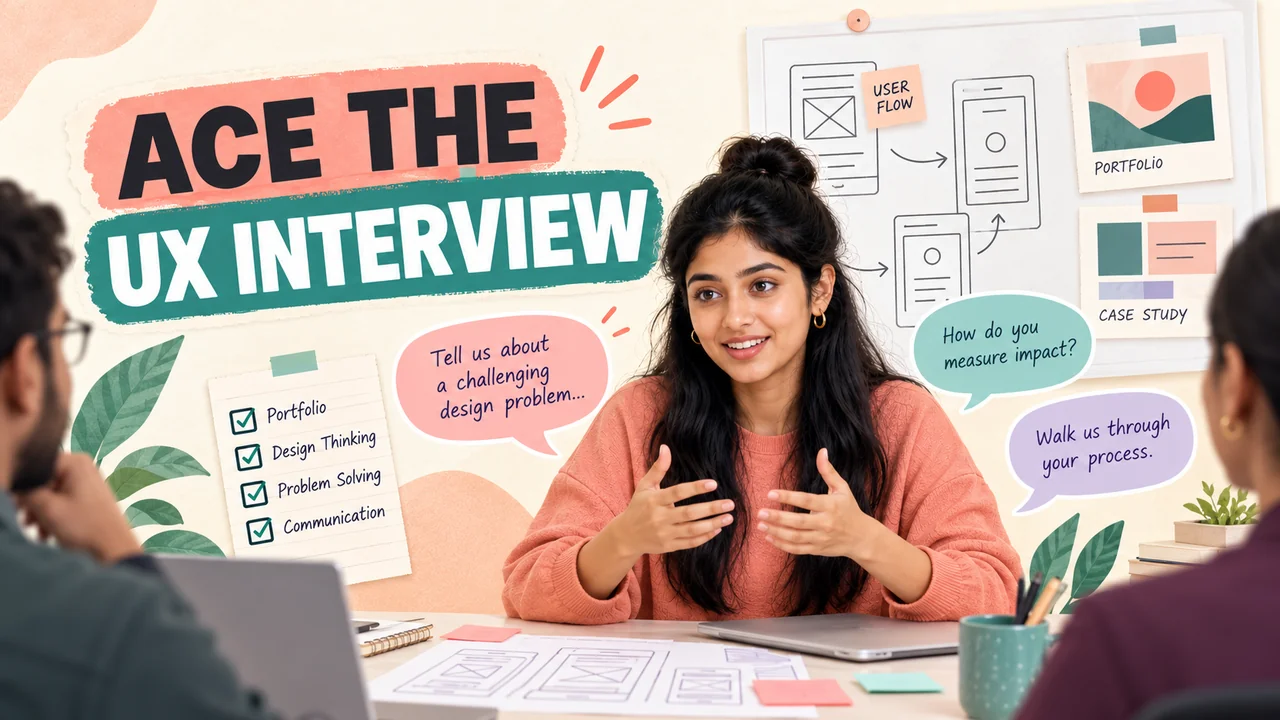
Interviewing for a UI/UX or product design role in 2026 goes far beyond showing pretty screens on Dribbble. Hiring managers at top tech companies and startups are looking for designers who can think critically about user problems, align their solutions with business goals, and communicate their decisions effectively to engineers and stakeholders.
Table of Contents
- Key Takeaways
- Portfolio Presentation Questions
- Whiteboard Design Challenges
- Behavioral & Collaboration Questions
- Salary & Interview Stages Data
- Factors Influencing Interview Success
- Common Mistakes to Avoid
- Advanced Tips from Hiring Managers
- Frequently Asked Questions
- Editorial scope
Key Takeaways
Process over polish
Interviewers care more about how you arrived at a solution than how the final screen looks.
Think out loud
During whiteboard challenges, silent designing is a red flag. Narrate your thought process.
Show the impact
Always connect your design decisions to user success metrics and business outcomes.
Collaboration matters
Expect questions about how you hand off files to developers and handle stakeholder feedback.
Detailed Breakdown: Portfolio Presentation Questions
The portfolio presentation is usually the most important hour of your interview process. You will be asked to walk through 1-2 case studies in depth. Review our UX case study guide to structure your work effectively.
1. "Walk me through this project. What was the core problem?"
How to answer: Start with context. Who is the user? What was their pain point? What was the business goal? Do not jump straight into Figma screens. Show that you understand the "why" before the "what."
2. "Why did you choose this specific research method?"
How to answer: Explain your constraints. If you chose user interviews over surveys, explain that you needed qualitative depth. If you used secondary research, mention time or budget constraints and how you mitigated bias.
3. "What alternatives did you explore before landing on this design?"
How to answer: Show your messy middle. Interviewers want to see that you explore multiple options. Show early sketches or wireframes that you discarded and explain why they failed usability testing or didn't meet business goals.
Detailed Breakdown: Whiteboard Design Challenges
Whiteboard challenges test your ability to think on your feet and collaborate. You are given a vague prompt (e.g., "Design a kiosk interface for a busy airport coffee shop") and expected to design a solution in 45 minutes.
The 5-Step Whiteboard Framework
- Ask clarifying questions: Who is the target user? What are the business constraints? Is it a touchscreen or mobile app?
- Define assumptions: State what you are assuming about the user's environment and tech literacy.
- Map the user journey: Draw a simple flowchart of the steps the user must take to achieve their goal.
- Sketch key screens: Draw low-fidelity wireframes. Focus on layout, hierarchy, and navigation, not typography or colors.
- Critique your own work: Point out potential edge cases or accessibility issues in your quick design.
Detailed Breakdown: Behavioral & Collaboration Questions
Product design is a team sport. Expect questions testing your soft skills and ability to work with product managers and engineers.
"Tell me about a time you disagreed with a Product Manager."
How to answer: Use the STAR method (Situation, Task, Action, Result). Focus on how you used user data or usability heuristic principles to advocate for the user, while still respecting the PM's business constraints. It is about healthy compromise, not winning an argument.
"How do you hand off your designs to developers?"
How to answer: Discuss your organizational skills in Figma. Mention auto-layout, component states, design tokens, and writing clear documentation or interaction notes. Showing empathy for developers is a massive green flag.
Is the ISS UI/UX Design programme right for you?
Review the curriculum for research, interface design, and portfolio projects. Compare the learning format, weekly commitment, fees, and support with your goals before applying.
View UI/UX Design curriculum →Salary & Interview Stages Data
Understanding the landscape helps you negotiate better. Here is a typical breakdown of the interview stages and salary expectations in India for 2026.
| Interview Stage | Typical Duration | Primary Focus | Who You Meet |
|---|---|---|---|
| HR Screen | 30 mins | Culture fit, salary expectations, timeline | Recruiter |
| Portfolio Review | 45-60 mins | Process, storytelling, craft quality | Design Lead / Senior Designer |
| Whiteboard Challenge | 60 mins | Real-time problem solving, collaboration | Design Team |
| App Critique | 45 mins | Design vocabulary, critical thinking | Product Manager / Designer |
| Founder / VP Round | 30 mins | Business alignment, long-term vision | VP of Product / Founder |
Compensation varies widely based on the company's funding stage and your ability to articulate business value. For detailed salary bands, see our UI/UX Designer Salary Guide.
Factors Influencing Interview Success
- Storytelling ability: Can you construct a narrative around your case study that keeps the interviewer engaged?
- Receptiveness to feedback: When an interviewer challenges a design choice, getting defensive is an instant fail. Responding with "That's a great point, I hadn't considered that edge case," shows maturity.
- Business acumen: Designers who understand metrics (e.g., conversion rate, churn, LTV) are significantly more valuable than those who only know color theory.
Common Mistakes / Myths
- Mistake: Designing silently during a whiteboard challenge. You must narrate your thoughts. The interviewer cannot grade what they cannot hear.
- Mistake: Skipping the "Why". Showing a beautiful final UI without explaining the research and wireframes that led to it.
- Myth: You must have a perfect solution. Interviewers know you only had 45 minutes for a challenge. They want to see your methodology, not a production-ready app.
- Mistake: Over-relying on buzzwords. Using terms like "design thinking" or "synergy" without being able to explain how you applied them practically.
Advanced Tips / Expert Insights
- Control the pace: During portfolio reviews, you are the presenter. Pace yourself, pause for questions, and ensure the interviewer is following your narrative.
- The "App Critique" secret: When asked to critique a popular app (like Spotify or Swiggy), don't just point out flaws. Discuss what they did well, why they might have made certain trade-offs, and how it aligns with their business model.
- Ask great questions at the end: When they ask "Do you have any questions for us?", ask about their design maturity. E.g., "How does design collaborate with engineering during the early planning stages of a feature?"
FAQs
What is the most common UI/UX interview question?
The most common question is asking you to walk through a project in your portfolio, focusing on the problem statement, your design process, and the outcomes or learnings.
How should I prepare for a whiteboard design challenge?
Practice defining the user problem clearly, asking clarifying questions, outlining the user journey, sketching low-fidelity screens, and explaining your design decisions aloud with a peer.
Do I need to know how to code for a UI/UX interview?
No, writing production code is rarely required. However, understanding basic HTML/CSS constraints and responsive behavior makes your developer handoff explanations much stronger and sets you apart.
What should I include in my portfolio presentation?
Include the initial problem statement, user research insights, iterations of your wireframes showing discarded ideas, the final high-fidelity design, and any metrics or outcomes demonstrating success.
How do I answer questions about handling negative feedback?
Frame feedback as an objective tool to iterate. Discuss a specific instance where constructive critique helped you refine a design, uncover a blind spot, and ultimately improve the user experience.
How long does a typical UI/UX interview process take?
It typically involves 3-5 rounds over 2-4 weeks, including a recruiter screen, a deep-dive portfolio review, a whiteboard challenge or take-home assignment, and a cultural fit interview.
Editorial scope
This article provides an editorial learning guide, not a survey of hiring outcomes. Examples illustrate approaches to practice; they do not predict employment or pay.
Conclusion / Next Steps
Succeeding in UI/UX interviews requires practice, clear communication, and a focus on process over visual perfection. Review your case studies, practice whiteboarding out loud, and prepare your behavioral stories using the STAR method.
If you need structured practice and expert critique to build interview confidence, consider joining the ISS UI / UX Design program where mock interviews and portfolio refinement are core components of the curriculum.
Want to check your cognitive fit before applying? Take our 20-minute admissions skills assessment and get a detailed pdf report.
Take Free Assessment →